Identification of contaminants of emerging concern through temporal trend analysis of suspended particulate matter in the Rhine River catchments (2005–2022): A case study using LC-HRMS to support early-warning systems
Mottaghipisheh, Javad; Selin, Erica; Kärrman, Anna; Larsson, Maria; Seilitz, Fredric Södergren; Koschorreck, Jan; Göckener, Bernd; Ahrens, Lutz
Journal of Hazardous Materials
Highlights
-
SS/NTS applied to archived SPM samples using LC-HRMS and computational tools
-
SPM matrices from two Rhine sites (2005 and 2022) analyzed for temporal trends
-
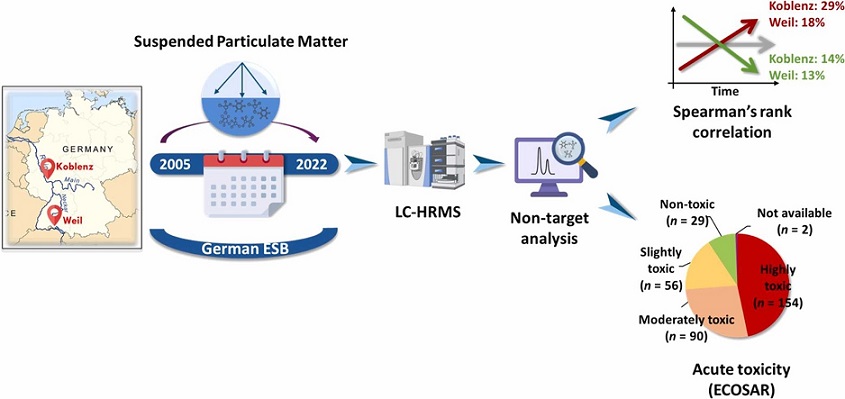
332 compounds identified; 29 % showed increasing time trends at Koblenz site
-
47 % of compounds were highly acutely toxic using ECOSAR models
-
SS/NTS of SPM archives supports early-warning-oriented risk management
Abstract
The continuous release of synthetic chemicals into aquatic systems underscores the need for long-term assessments of contaminants of emerging concern (CECs). Archived suspended particulate matter (SPM) samples from the German Environmental Specimen Bank (ESB) (2005–2022) at two Rhine sites (Weil am Rhein and Koblenz) were analyzed using liquid chromatography–high-resolution mass spectrometry (LC-HRMS) suspect/non-target screening (SS/NTS) to evaluate temporal trends. Using retention-time indices and orthogonal MS/MS evidence (mzCloud, FISh, CFM-ID), 332 compounds were identified at varying Schymanski confidence levels (2.1: 3.0 %; 2.2: 5.7 %; 3.1: 53 %; 3.2: 38 %). Temporal analysis of LC-HRMS peak areas revealed that 25 % of contaminants increased over time, with a higher proportion at Koblenz (29 %) than Weil (18 %). Conversely, several compounds exhibited statistically significant decreasing trends at both Koblenz (14 %) and Weil sites (13 %), consistent with regulatory measures, improved wastewater treatment, and shifts in industrial practices. Aquatic toxicity prediction (ECOSAR) indicated that 47 % (154 of 332) of annotated structures were highly acutely toxic (LC₅₀/EC₅₀ ≤ 1 mg/L) to at least one test group (fish, Daphnia, or green algae).
This study provides the first 18-year, site-specific non-target time series from a national archive and integrating orthogonal identification with hazard prediction to support chemical prioritization. Archived SPM enables retrospective and comparable assessment of particle-associated contaminants, complementing dissolved-phase monitoring, and supporting the identification of unmonitored emerging CECs. Crucially, long-term NTS of these SPM samples provides screening-level early-warning signals and a watch list for targeted confirmation and risk management.
doi.org/10.1016/j.jhazmat.2025.140993
Graphical Abstract