Tracking the impact of PFAS regulations: Long-Term analysis of roe deer livers from 1998 until 2022
Müller, Viktoria; Preihs, Marc; Caldeira, Thiago I; Göckener, Bernd; Mesko, Marcia F; Koschorreck, Jan; Feldmann, Jörg
Environmental Pollution
Highlights
-
Long-term PFAS trends assessed in roe deer livers (1998–2022).
-
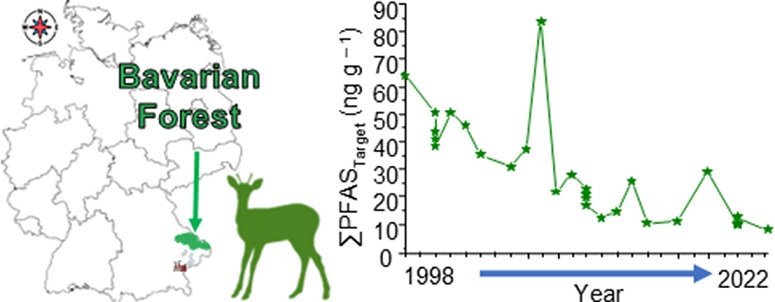
Target PFAS declined from 64 to 8 ng g−1, mainly due to PFOS phase-outs.
-
PFCA share increased while PFSA contribution markedly decreased.
-
Large fluorine gap highlights need for comprehensive PFAS ban.
Abstract
Per- and polyfluoroalkyl substances (PFAS) are persistent environmental pollutants with widespread occurrence and bioaccumulation potential. Regulatory measures have been introduced to limit the use of certain PFAS, yet their presence remains detectable in wildlife. This study examines long-term trends in PFAS concentrations in one-year-old roe deer livers (n = 28) collected from the Bavarian Forest National Park between 1998 and 2022.
Targeted analysis revealed that ΣPFAStarget significantly declined over the years (64–8 ng gꟷ1), driven by the decrease in perfluorooctane sulfonic acid (PFOS) concentrations from 43 to 0.7 ng gꟷ1, aligning well with phase outs and restrictions. Between 1998 and 2022, ΣPFCAtarget accounted for 28 %–76 % of the ΣPFAStarget while ΣPFSAtarget decreased from 71 % to 20 % by 2020. Methanol extractable organic fluorine (EOF) content was <115 ng F gꟷ1., while total fluorine (TF) content in the livers was found up to 5900 ± 430 ng F gꟷ1.
As fluoride does not typically accumulate in soft tissues, the results emphasize the need for improved detection methods for EOF. These findings highlight the limitations of substance-specific regulations and reinforce the necessity for a comprehensive PFAS ban to prevent further environmental contamination.
doi.org/10.1016/j.envpol.2026.127685
Graphical abstract